Summary:
Most homeowners start their renovation research online and walk away more confused than when they started. One site says $50,000. Another says $300,000. Neither one mentions that you live on Long Island, where labor rates, material costs, and building codes operate in their own world entirely.
If you’re planning a full home renovation in Suffolk County, the numbers that matter are the local ones. We’ve put together this guide to cover what a whole house renovation actually costs here, how to build a budget that doesn’t fall apart mid-project, and what we know about Long Island homes that the national websites don’t.
Full Home Renovation Cost: What Suffolk County Homeowners Actually Pay
The honest answer is that full home renovation costs in Suffolk County typically run between $185 and $300 per square foot, with the average complete renovation landing around $195,000 to $240,000 depending on scope, finishes, and what’s discovered once the walls come down. That’s meaningfully higher than what you’ll see quoted on national home improvement sites, and there are real reasons for it.
Long Island labor rates for skilled trades run above national benchmarks. Material delivery to Suffolk County adds cost. And the county’s building code enforcement is active — meaning permits aren’t optional, and the work has to be done right the first time. If your project falls under $50,000, expect a permit fee of $250 through Suffolk County. For projects up to $100,000, that fee is $500. Modest numbers, but they’re part of the picture.
Whole House Renovation Cost Breakdown by Room and Scope
The range between $185 and $300 per square foot tells you where you’ll land, but it doesn’t tell you what’s driving the number. Breaking it down by room gives you a clearer picture — and helps you make smarter decisions about where to invest and where to pull back.
Kitchens are consistently the biggest line item in a full renovation. On Long Island, a mid-grade kitchen remodel starts around $30,000 and climbs quickly once you factor in layout changes, custom cabinetry, or upgraded appliances. Budget-level kitchen updates can come in around $20,000 to $25,000, but that assumes you’re keeping the existing layout and going with stock materials.
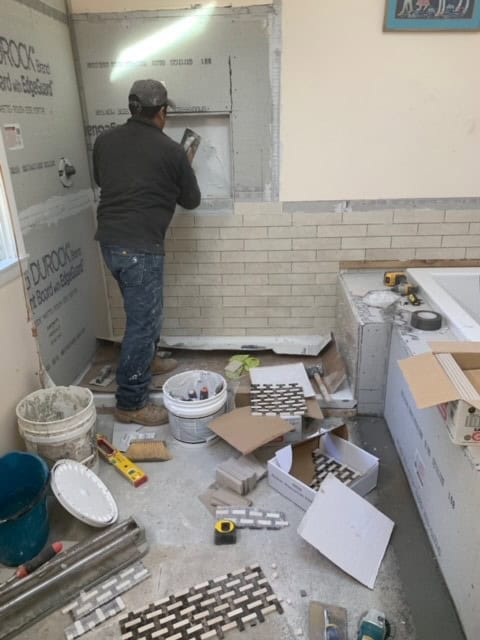
Bathroom remodeling follow a similar pattern. A basic bathroom refresh on Long Island starts around $15,000 for a smaller space. Mid-grade renovations with new tile, vanity, fixtures, and updated plumbing typically run $21,000 to $40,000. If you’re doing a primary bath with a walk-in shower, soaking tub, and heated floors, budget $40,000 and up.
Living spaces — open floor plan conversions, removing walls, refinishing floors, updating trim and lighting — tend to run $20,000 to $50,000 depending on whether structural changes are involved. Pure cosmetic updates like paint, flooring, and fixtures across multiple rooms can be done for $5,000 to $15,000, though that rarely moves the needle on a full renovation.
One area that often gets underestimated is the basement. Finishing an unfinished basement in Suffolk County typically costs between $30,000 and $150,000 depending on the size, the level of finish, and whether you’re adding a bathroom, egress windows, or a separate living space. On a per-square-foot basis, expect $50 to $150. It’s one of the higher-ROI investments you can make in a Long Island home, particularly given how much usable square footage it adds without touching the footprint.
The scope of your renovation — cosmetic refresh versus full gut — is ultimately what moves the number most. A cosmetic update touches surfaces. A gut renovation touches everything: walls, floors, ceilings, mechanical systems, and sometimes the structure itself. If your home was built in the 1960s or 1970s, which describes a significant portion of the housing stock in towns like Huntington, Smithtown, and Commack, there’s a good chance a full renovation becomes a gut renovation once the demo starts.
Hidden Renovation Costs That Catch Suffolk County Homeowners Off Guard
The budget you build before demo starts is never the final number. That’s not a contractor problem — it’s just the reality of working inside older homes. What you see from the outside tells you almost nothing about what’s behind the drywall.
Suffolk County’s housing stock skews heavily toward homes built between the 1950s and 1980s. That’s not a problem on its own, but it does mean those homes are now 40 to 70 years old. Electrical panels from that era are frequently undersized or wired with materials that no longer meet code. Replacing an outdated panel runs $1,400 to $2,800. If the home still has galvanized steel plumbing, full replacement can cost $10,000 to $30,000. Outdated wiring — whether knob-and-tube or early aluminum — adds another $3,000 to $8,000 to address properly.
Then there’s the environmental side. Homes built before 1978 may contain lead paint. Homes from the 1950s through the mid-1980s sometimes have asbestos in insulation, floor tiles, or around pipes. Remediation for either issue typically runs $5,000 to $15,000 depending on how much material is involved. These aren’t rare edge cases in Suffolk County — they’re common enough that we plan for the possibility from the start on every project.
Beyond what’s inside the walls, there are costs that homeowners simply forget to budget for. Temporary housing during a major renovation can run $2,000 to $10,000 per month depending on how long the project takes and where you stay. Disposal and dumpster fees add up. Final inspections, utility reconnections, and touch-up work after the main crew wraps all have a cost.
The industry standard recommendation is to add a 15 to 20 percent contingency to whatever budget you’ve built. That’s not padding — it’s the difference between a renovation that stays on track and one that stalls when the first unexpected discovery shows up. On a $200,000 project, that’s $30,000 to $40,000 held in reserve. It feels like a lot until you actually need it.
Building a Home Renovation Budget That Holds in Suffolk County
A realistic home renovation budget isn’t just a number — it’s a plan. It accounts for what you know, what you don’t know yet, and how you’ll handle the gap between the two. Most renovation budgets that fall apart do so because one of those three pieces was missing.
The starting point is always scope. What are you actually renovating? A full gut of a 1,800-square-foot ranch in Babylon is a very different project from a cosmetic refresh of a newer colonial in Sayville. Getting specific about scope before you call a contractor is the single most useful thing you can do to get accurate estimates and avoid sticker shock later.
How to Phase a Whole House Renovation Without Losing Your Mind
Most whole house renovations don’t happen all at once, and that’s usually a good thing. Phasing a renovation gives you more control over cash flow, lets you stay in the home during parts of the project, and allows you to adjust scope based on what’s discovered in earlier phases.
A logical phasing sequence for a full renovation typically starts with anything structural or mechanical — foundation repairs, electrical upgrades, plumbing replacement, HVAC. These are the systems that everything else depends on, and they need to be right before you put finishes on top of them. Doing it in the wrong order means tearing out finished work to fix something underneath, which is expensive and avoidable.
Once the bones are right, exterior work usually comes next — roofing, siding, windows. In Suffolk County, this is especially important because the coastal climate is hard on exterior systems. Salt air accelerates corrosion. Nor’easters test every seal and fastener. Getting the envelope tight before you move to interior finishes protects everything you’re about to invest inside.
Interior renovations — kitchens, bathrooms, flooring, painting — come last. These are the visible transformations that tend to drive the emotional decisions, but they’re the final layer, not the foundation. Homeowners who want to do the kitchen first because that’s the most exciting part sometimes end up redoing work when a plumbing issue or electrical upgrade disrupts a finished space.
Phasing also helps with budgeting because it breaks a large number into smaller, more manageable decisions. You’re not committing to $200,000 upfront — you’re committing to Phase 1, evaluating what you learned, and then planning Phase 2 with better information. We structure that sequence in a way that minimizes disruption and keeps the project moving forward.
What Suffolk County Homeowners Ask Most About Renovation Costs
A few questions come up consistently when homeowners in this area start planning a full renovation. They’re worth answering directly.
Do I need a permit for a home renovation in Suffolk County? Yes, for most work that goes beyond cosmetic updates. Any project involving structural changes, electrical work, plumbing, or HVAC requires a permit through the town and in many cases the county as well. Suffolk County requires all home improvement contractors to be licensed through the Department of Labor, Licensing & Consumer Affairs — and part of working with a licensed contractor is that they pull the permits. Skipping permits to save time or money creates problems at resale, can void your homeowner’s insurance, and can result in fines or mandatory removal of completed work. It’s not worth it.
How do I know if a contractor is actually licensed in Suffolk County? You can verify a home improvement contractor’s license directly through the Suffolk County Department of Labor, Licensing & Consumer Affairs. Any legitimate contractor operating in the county should be able to give you their license number without hesitation. We’re happy to provide ours. Suffolk County also maintains a Licensed Home Improvement Contractor Restitution Fund, which provides homeowners with a layer of recourse if a licensed contractor fails to complete work. That protection doesn’t exist with unlicensed contractors.
Will the national cost estimates I’ve seen online apply to my project in Huntington or Smithtown? Rarely. National averages consistently underestimate what renovations cost on Long Island. Labor rates here are higher, material delivery adds cost, and local code requirements are specific. A homeowner who budgets based on a national website and then gets quotes from Suffolk County contractors is almost always surprised. The more useful comparison is local data — which is why the per-square-foot ranges we cite ($185 to $300 for a full renovation) come from Long Island-specific sources, not national aggregates.
Is a full home renovation worth it financially in Suffolk County? In most cases, yes — particularly given where home values sit. With Suffolk County’s median home price around $690,000, a well-executed renovation can return a meaningful percentage of its cost in added value. Kitchen and bathroom renovations typically return 60 to 80 percent in this market. Beyond the financial return, many homeowners in towns like Commack, Brookhaven, and Patchogue are choosing to renovate rather than sell precisely because the cost of buying in today’s market — at current interest rates — makes staying and improving the smarter financial move.
Ready to Get a Real Number for Your Suffolk County Renovation?
The hardest part of planning a full home renovation isn’t the renovation itself — it’s getting to a number you can actually trust. One that accounts for where you live, how old your home is, what the local permit process looks like, and what’s likely hiding behind your walls.
That’s exactly the kind of estimate we put together for homeowners across Suffolk County. We’ve been doing this work here for over 20 years, and we know what these projects actually cost — not what a national website guesses. No inflated numbers to cover surprises we didn’t plan for, and no lowball bids that fall apart once the demo starts.
If you’re in the early stages of planning or you’ve already gotten quotes that don’t add up, reach out to us. We’re local, we’re licensed, and we’re straightforward about what things cost and why.