Summary:
A storm rolls through. You hear something hit the roof. The next morning, there’s a water stain on your ceiling that wasn’t there yesterday. Or maybe it’s worse — water is actively coming in, and it’s 10 o’clock at night.
That moment is stressful in a way that’s hard to describe. You need someone fast, you don’t know who to call, and you’ve probably heard enough stories about Suffolk County roofing scams to make you hesitant to call anyone at all.
This page is meant to help you move quickly and move smart. We’ll cover what to do in the first 24 to 48 hours, how to verify who you’re actually dealing with, and why having a local general contractor in your corner makes a real difference when the damage goes beyond just the roof.
What to Do After Storm Damage to Your Roof in Suffolk County
The most important thing to understand is that storm damage compounds. Water that enters through a compromised flashing joint or a section of missing shingles doesn’t just sit there — it migrates into the sheathing, into the insulation, into the drywall. What starts as a manageable repair can turn into a much larger remediation job within 48 hours, especially if another rain event moves through before anything is addressed.
The first step is emergency tarping. Temporary tarping stops active water intrusion while you figure out the full scope of what happened. It doesn’t require a building permit in Suffolk County, which means it can happen the same day. It’s not a permanent fix, but it buys you the time to make good decisions instead of panicked ones.
After that, the priority is documentation. Photograph everything — the damage on the roof, the interior water intrusion, any structural issues you can see. Your insurance company will want this, and a contractor worth hiring will want it too.
How to Spot a Storm Chaser Contractor on Long Island Before It's Too Late
After every major nor’easter or hurricane that moves through Suffolk County, a predictable wave of out-of-area contractors follows. They knock on doors. They offer to “check your roof for free.” Some of them create damage that wasn’t there before and then charge you to fix it. CBS News has covered Long Island-specific roofing scam operations where homeowners were charged tens of thousands of dollars by operators who had no local license, no insurance, and no intention of standing behind their work.
This isn’t a rare edge case. It’s a documented, recurring problem in this county — and it happens precisely because the panic of storm damage makes people vulnerable to anyone who shows up and sounds confident.
Here’s the most important thing you can do before agreeing to anything: ask for the contractor’s Suffolk County Home Improvement Contractor (HIC) license number. New York State doesn’t issue a statewide roofing license — licensing is handled at the county level. In Suffolk County, every home improvement contractor is required to hold an HIC license issued by the Suffolk County Department of Labor, Licensing & Consumer Affairs under Suffolk County Code 563. This applies to every town in the county, from Babylon to Southold.
A legitimate contractor will give you that number without hesitation and will actively encourage you to verify it. You can check it directly through the Suffolk County Department of Labor’s public contractor database. If someone hedges, changes the subject, or tells you the license is “in process,” that’s your answer.
Beyond the license, ask whether they carry general liability insurance and workers’ compensation coverage. Workers’ comp matters more than most homeowners realize — if a worker is injured on your roof and the contractor doesn’t carry coverage, you can be held liable. That’s not hypothetical. It happens.
One more red flag worth knowing: the industry standard for contractor deposits is somewhere between 10 and 30 percent at contract signing. If someone is asking for more than half the total cost upfront before a single piece of work is done, walk away. That pattern shows up repeatedly in roofing fraud cases on Long Island.
Does Homeowners Insurance Cover Emergency Roof Repair in Suffolk County?
Usually, yes — but the details matter more than the general answer. Storm damage caused by a nor’easter, hurricane, or other weather event is typically covered under a standard homeowners insurance policy. What can complicate or even void a claim is how the repair was handled afterward.
If you hire an unlicensed contractor and something goes wrong, your insurer may have grounds to deny the claim. If repairs were done without the required permits and your insurer finds out later — potentially during a future claim or a home sale — that unpermitted work can create serious problems. We pull permits as standard practice, and that’s not just bureaucratic box-checking. It’s what protects you.
The documentation piece matters here too. Insurance adjusters need to see the scope of the damage clearly and in writing. A contractor who works regularly with insurance claims will know how to document the damage in a way that supports your claim rather than creating gaps an adjuster can use to reduce the payout.
Suffolk County homeowners who’ve been through Superstorm Sandy or the nor’easters that followed know how complicated the insurance side of storm damage can get. The claims process is rarely as simple as “call your insurer, get a check.” Having a contractor who understands that process — and can communicate directly with your adjuster — is worth more than most people realize until they’re in the middle of it.
One thing to keep in mind: the permit requirement applies to full roof replacements and permanent structural repairs. Emergency temporary tarping does not require a permit and can proceed immediately. Knowing that distinction can help you move fast on the protective step without waiting on paperwork.
Why a General Contractor Handles Storm Damage Better Than a Roofing-Only Company
Here’s something that doesn’t come up enough in conversations about emergency roofing: storms rarely damage just the roof. A strong nor’easter that strips shingles off your home in Patchogue or Brookhaven is also likely to have done something to your siding, your windows, and potentially the interior spaces where water found its way in.
A roofing-only company can fix the roof. But then you’re back on the phone trying to find a siding contractor with availability, a window company that can fit you in, and someone to look at the water-damaged drywall inside. Each of those contractors has their own schedule, their own deposit, and their own timeline.
We handle all of it. Roofing, siding, windows, and interior repairs — one call, one crew, one timeline. That matters a lot when you’re already managing the stress of storm damage.
Roof Repair vs. Full Roof Replacement After a Storm — How Do You Know Which One You Need?
This is one of the most common questions homeowners ask after storm damage, and it’s a fair one. The honest answer is that it depends on the age of the roof, the extent of the damage, and what the inspection reveals — and any contractor who gives you a definitive answer before actually getting on the roof should be treated with some skepticism.
That said, there are patterns worth knowing. If the damage is localized — a section of shingles blown off, a compromised flashing joint, a small area of impact damage — repair is often the right call. If the roof is already at or past the end of its expected lifespan and the storm exposed underlying vulnerabilities, replacement may make more sense economically. Repairing a roof that’s going to need replacement in two years anyway can end up costing more in the long run.
Suffolk County’s coastal conditions accelerate roof wear in ways that inland markets don’t experience. The salt air that comes off the Great South Bay and the Atlantic corrodes fasteners and flashing faster than most people expect. A roof that might perform well for decades in a different climate often shows its age more quickly here.
What we do is give you an honest assessment in writing. You’ll know what we found, what we recommend, and why. If a repair is the right answer, that’s what we’ll tell you. If the inspection reveals that a full replacement is the more cost-effective path, we’ll explain that clearly too, with a written, itemized estimate so you know exactly what you’re looking at before you make any decisions.
What Makes Rich's Construction Different for Emergency Roofing in Suffolk County
We’re based in Patchogue. We work throughout Suffolk County — Brookhaven, Islip, Babylon, Huntington, Smithtown, and beyond. We know the building departments across the county’s ten towns, we pull permits as standard practice, and we’ve been doing this work here long enough to understand what Suffolk County homes go through weather-wise.
That local presence matters in a few practical ways. We’re not learning your town’s permit process on the fly. We’re not unfamiliar with what a South Shore home looks like after a Category 1 brushes the coast or a nor’easter stalls over Long Island for two days straight. We’ve seen it, we’ve repaired it, and we know what to look for.
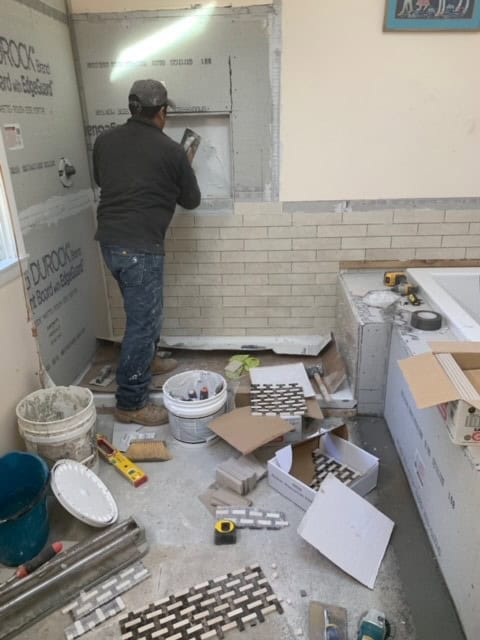
We’re also a full-service general contractor, which means we’re not limited to the roof. If the same storm that damaged your shingles also compromised your siding or left you with a window that’s no longer sealing properly, we handle that too. We’ve worked on kitchens and bathrooms where water intrusion from a roof failure worked its way down and caused damage that wasn’t visible for weeks. That kind of whole-home perspective is something a roofing-only company simply can’t offer.
We carry general liability insurance and workers’ compensation coverage. We hold our Suffolk County Home Improvement Contractor license. We’re BBB accredited with an A+ rating. We provide written, itemized estimates — not verbal quotes that shift when the work starts. And we work with insurance adjusters directly, which takes a significant amount of the claims burden off your plate.
Suffolk County homeowners have options after a storm. Our job is to make sure you have the information to choose the right one — and to be ready when you do.
Emergency Roofing Help in Suffolk County — What to Do Right Now
If your roof has been damaged by a storm, the most important thing is to act quickly and verify carefully. Get temporary tarping in place to stop active water intrusion. Document the damage before anything is touched. Ask any contractor you speak with for their Suffolk County HIC license number and verify it before signing anything.
The 24 to 48 hours after storm damage are the window that matters most. Every rain event that follows before the roof is protected adds to the scope and the cost.
If you’re in Suffolk County and you need someone who knows the area, knows the permit process, and can handle the full scope of what a storm leaves behind — reach out to Rich’s Construction. We’ll give you a straight answer and a written estimate, and we won’t disappear when the job is done.