Summary:
If your roof has been giving you reasons to worry — a stain on the ceiling after a hard rain, granules collecting in the gutters, flashing that’s been questionable for a season or two — you already know what’s coming. A Long Island winter is not a forgiving test. Nor’easters, heavy snow loads, and the relentless freeze-thaw cycle that runs from December through March have a way of turning a manageable situation into an urgent one fast.
The good news is that waiting until spring isn’t your only option, and in many cases, it’s not even the smarter one. At Rich’s Construction, we’ve been replacing roofs through Suffolk County winters for years. Here’s what homeowners in Patchogue and across the county need to know about replacing a roof before — or during — winter.
Why Winter Roof Replacement Makes Sense for Suffolk County Homeowners
There’s a widespread assumption that roofing work stops when the temperature drops. That’s not how we work. The real question isn’t whether winter replacement is possible — it’s whether your roof can survive another winter without one.
Suffolk County has weathered 45 hurricanes since 1930, and that doesn’t count the nor’easters, ice storms, and coastal wind events that roll through every season. A roof that’s already past its effective lifespan — typically 15 to 20 years for asphalt shingles in New York’s coastal, freeze-thaw climate — is carrying real risk into every storm.
Waiting until spring means months of additional exposure. By the time contractors are fully booked in April, you may have already dealt with a winter’s worth of interior water damage. That’s when we see the most expensive repairs — not from the original roofing failure, but from what happened while homeowners were waiting for better weather.
What Actually Happens to a Failing Roof During a Long Island Winter
Most people picture roof damage as something visible — missing shingles, an obvious leak, water dripping through a ceiling. But some of the most serious roofing failures we see in Suffolk County start somewhere the homeowner never looks: the attic.
Moisture accumulates, insulation loses its effectiveness, and wood decking begins to degrade long before anything shows up on the surface. By the time you see a stain on your ceiling, the damage has usually been building for a while.
Then winter arrives and accelerates everything. Snow load is a genuine structural concern — heavy nor’easters can push significant weight onto a roof that’s already dealing with compromised decking. Ice dams are another issue specific to this region. When heat escapes through an under-insulated attic, it melts snow at the roof’s surface. That water runs down toward the eaves, hits the cold overhang, and refreezes.
The ice backs up behind the dam and forces water underneath the shingles — exactly where you don’t want it. Communities along the South Shore, including areas around Patchogue, Bayport, and Sayville, see this play out every January and February.
The freeze-thaw cycle compounds the problem further. Long Island doesn’t stay frozen all winter — temperatures swing across the freezing point repeatedly, and every cycle gives water another opportunity to expand inside any crack or gap in the roofing system. Over time, this works shingles loose, widens gaps in flashing, and accelerates deterioration that a replacement would have stopped entirely.
Proper ice and water shield installation at the eaves and valleys, combined with balanced attic ventilation, prevents the vast majority of ice dam damage. But that protection only exists on a roof that’s been installed correctly — not one that’s been patched together over the years or that’s quietly failing from the inside.
Can You Actually Replace a Roof in Winter on Long Island?
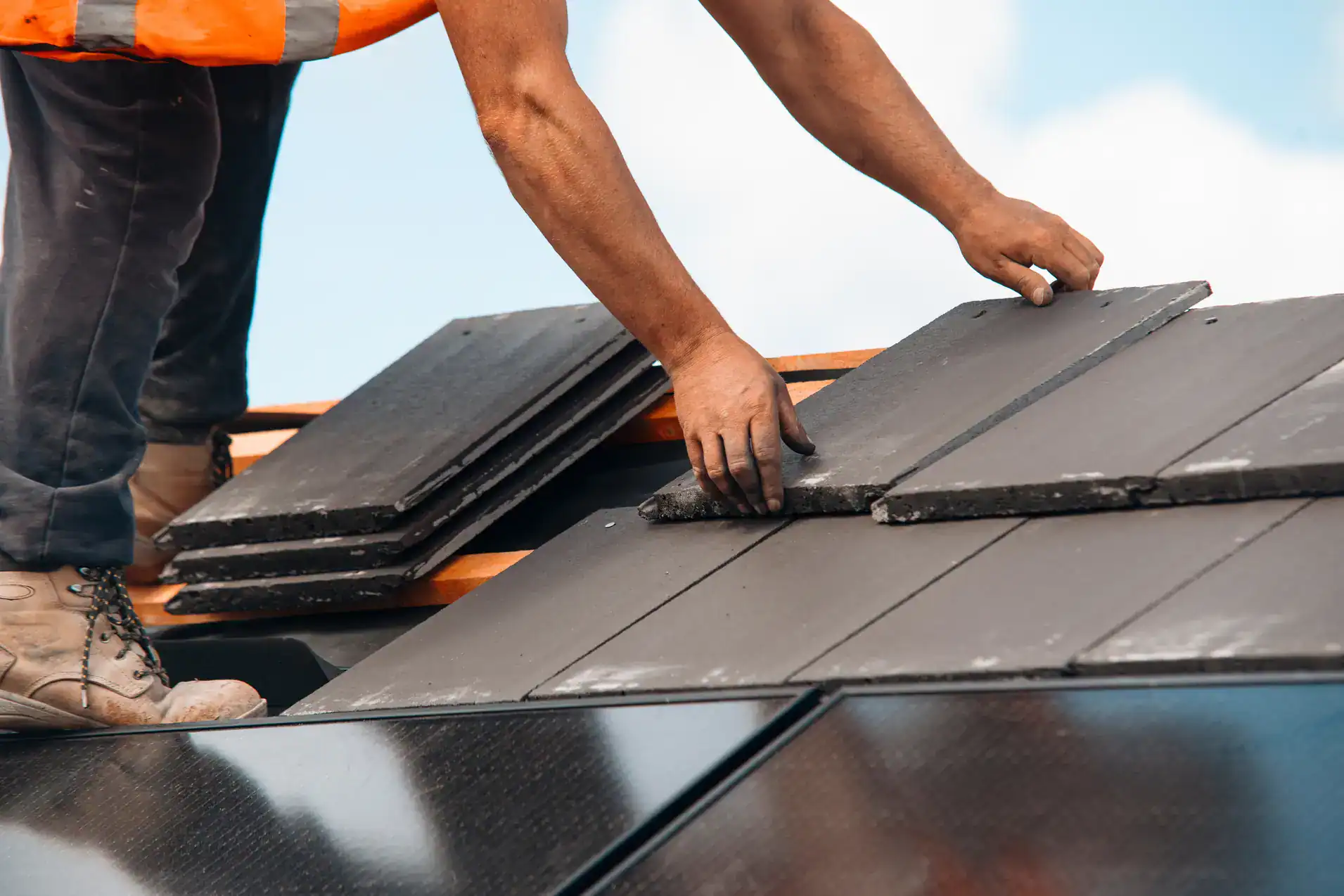
Yes — and we’ve been doing it for years. Cold-weather roofing requires planning and the right techniques, but it’s not the obstacle most homeowners assume it is. Our crews work around weather windows, use cold-weather installation methods that keep material warranties intact, and take the additional precautions needed to protect your home during the process.
There’s also a practical upside to winter timing that doesn’t get talked about enough: contractor availability. Spring and summer are peak demand seasons across Suffolk County. After every major storm, the backlog grows fast. Scheduling a replacement in late fall or winter often means a shorter wait, faster project completion, and more direct attention to your job — because our crews aren’t stretched across a dozen projects simultaneously.
The materials question comes up often, and it’s worth addressing directly. Asphalt shingles — the most common roofing material in Suffolk County — can be installed in cold weather when proper techniques are used. Adhesive strips on shingles need time to seal, and our experienced installers account for that. The result, when done right, is a roof that performs exactly as it should when spring arrives.
What makes the difference isn’t the season — it’s the contractor. A company that understands Long Island’s specific climate, knows how to plan around weather, and has years of experience working through Suffolk County winters is a fundamentally different proposition than one that’s guessing. That local knowledge shows up in how a job is planned, how materials are handled, and whether the finished roof actually holds up when the next nor’easter comes through.
What to Look for in a Roofing Replacement Contractor in Suffolk County
After a significant storm, Suffolk County sees an influx of out-of-town contractors. They show up with low bids, take deposits, and in too many cases, disappear before the job is done right — or at all. It’s a well-documented pattern on Long Island, and it’s one of the most common reasons homeowners end up in a worse position than when they started.
The contractor you choose matters as much as the materials they use. A locally owned company that knows Suffolk County’s building departments, pulls proper permits, and will still be reachable six months after the job is finished is a different thing entirely from someone driving in from out of state.
Does a Roofing Contractor in Suffolk County Need a License?
This is one of the most important questions a homeowner can ask — and one that too many people skip. In Suffolk County, any contractor working on a residential property is legally required to hold a Home Improvement Contractor (HIC) license issued by the Suffolk County Department of Labor, Licensing & Consumer Affairs. There is no statewide roofing license in New York. Licensing requirements are set at the county level, and the HIC credential is what applies here.
It goes further than that. East Hampton, Southampton, and Shelter Island each require their own separate licensing, even when a contractor already holds a valid Suffolk County credential. The county’s ten towns each have their own building departments with their own permit requirements, and roofing work requires a permit in virtually every jurisdiction.
A contractor who suggests skipping the permit to save time or money is a contractor you should walk away from immediately. Unpermitted roofing work can void your homeowner’s insurance claim and create serious complications if you ever try to sell your home.
We pull permits as a matter of course. We know which building department to contact in Patchogue and across Suffolk County, what documentation is required, and how to get the job through inspection without putting you in a difficult position. That’s not an extra service — it’s what the job is supposed to include.
How to Compare Roofing Replacement Quotes Without Getting Burned
Getting multiple estimates is smart. But comparing them on price alone is where homeowners get into trouble. A lower bid doesn’t always mean a better deal — it often means something important has been left out of the scope.
A complete roofing replacement in Suffolk County should include a full tear-off of the existing shingles rather than layering over them, an inspection of the underlying decking with replacement of any damaged sections, ice and water shield installation at the eaves and valleys — critical in Long Island’s freeze-thaw climate — proper underlayment, new flashing around all roof penetrations including chimneys and vents, drip edge installation, and ridge ventilation.
When you get a quote that’s significantly lower than the others, the question to ask is: what’s not in here?
Warranty coverage is another area where quotes diverge in ways that aren’t immediately obvious. There are two warranties involved in any roofing replacement: the manufacturer’s material warranty, which covers the shingles themselves, and the contractor’s workmanship warranty, which covers how the installation was done. Both matter. A 30-year shingle warranty doesn’t protect you much if the installation was poor and the workmanship warranty is nonexistent or unenforceable because the contractor is no longer operating locally.
Ask for both warranties in writing before signing anything. Ask whether the contractor carries general liability insurance and workers’ compensation coverage — and verify it. Ask for references from recent jobs in Suffolk County specifically, because a contractor who’s worked extensively in this region will have neighbors you can actually call. These aren’t difficult questions for a reputable contractor to answer. If the answers are vague or the documentation is slow to appear, that tells you something important.
Ready to Replace Your Roof Before the Next Suffolk County Storm?
A compromised roof heading into a Long Island winter isn’t just an inconvenience — it’s a liability. The snow load, the ice dams, the freeze-thaw cycles, the coastal winds off the Great South Bay — none of it is gentle on a roofing system that’s already past its prime. And the cost of waiting, measured in interior water damage, emergency repairs, and energy loss, almost always exceeds the cost of replacing the roof when the timing is right.
The most important thing you can take from this is that winter replacement is a real option — and for many Suffolk County homeowners, it’s the right one. The key is working with a contractor who knows this region, handles the permit process without putting it back on you, and will still be around to stand behind the work after the job is done.
If your roof has been on your mind, reach out to Rich’s Construction for a free estimate. We’re based in Patchogue, we serve homeowners throughout Suffolk County, and we’re not going anywhere after the job is finished.